"Vision
of A New Culture"
The
Great Learning
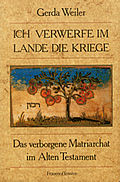
Mother of Israel
From G.Weiler "I condemn
the
wars in this country", 1986 Frauenoffensive
English summary
1. THE FORGOTTEN ROOTS OF OUR CULTURE
The beginning
Early mankind experienced the transcendental power as feminine: covering as space, shell, cave, house and the curving heaven - threatening as a landscape of death, as mountains, desert and the see. People made their experiences visible in a symbol and worshipped the creative power as Queen of Heaven, the Lady of the world.
The adventurous journey to our origins
leads us from the West to the East. There, in the Middle East the creation myth has originated. We refer to it, as we say that Adam and Eve were the "first human beings". In the Old Testament the social norms, that determine our life have been moulded. Their principles of patriarchal masculinity and patriarchal femininity are still - unconsciously, but therefore more lasting - influencing our state in this world. However, in consciously and critically examining our origins, we will meet the matriarchal primordial substance, in which the Old Testament is rooted as well.
Ras-Schamrah - the re-discovery of a matriarchal culture
Since 1928, on the Syrian coast, an excavation of historic dimensions is going on. Until now Canaaite culture was only known through written records of other people. For the first time, we are coming up to a Canaaite city state, together with its temples and palaces, with its material and spiritual culture, in particular with its unknown religion. The parallels to the Old Testament are striking and ask for a revision of the common exegesis.
The matriarchal concept of God
The matriarchal „God" isn't the Father, but the Son. Horus is the Son of Isis, Adonis is Astartes' Son. The matriarchal God isn't the creator, but the creature. He isn't Lord of Heaven, but embodies the earth and its vegetation. The matriarchal God is mortal. His cult representative on the earthly throne is selected by the high-priestly queen and subsequently entrusted with the kingdom.
Ba‘al means „Master". Adon means „Lord" or simply „Man". Jahwe-Adonai is also - according to the original meaning - nothing but the masculine-earthly "Lord" in the context of the cosmic Queen. He is the „Man", the primordial masculine creature of the Mistress of Heaven. The matriarchal consciousness sees the embodiment of the comprehensive masculine power - the fertilizing impulse - in the symbol of the bull. By calling this power "God", we are projecting a concept, that in Western consciousness only later emerged, backwards into the past, into an era in which masculinity didn't have any cosmic dimension.
2. MAIN PART
„We want to sacrifice incense to
the Queen of
Heaven and drinks"
Resistence against deep-rooted prejudices
The Old Testament as it is currently known, is of much earlier time than commonly perceived. It expresses a masculine world view, while projecting a "unified" history and a monotheistic God "at the beginning of time". Women should have the courage to oppose the authority of the "Fathers" by a world view of their own. By liberating the Old Testament texts from their tendentious superstructure, the matriarchal cult hymns appear in front of our eyes. Furthermore, we will discover, that the matriarchal piety is including a social ethics, that exceeds by far the at random institutionalized order, dictated by Jewish religious laws.
Patriarchal primordial monotheism doesn't exist
The „monotheistic" God Israels has many Names, he is El and El~Saddai, the God of the mountain, he is the "strong one" (Bull-god) of Jacob, while only later the manifold "patriarchs" were united with Jahwe by levitic theology.
The „monotheistic" God Israels has many places of worship, while not at home in any of them. He only wants to be worshipped in Jerusalem. However, this city belonged to Salem, the Venus-god, together with the worship of his wife Aserat. This has been confirmed by both archeological as well as biblical (...) sources.
Jahwe
wants to be the God of the covenant of the northern israelite
tribes, but the covenant with
the "twelve" tribes proves to be a
backward projection. Finally,
Jahwe wants to be a God of the
desert, one who is wandering
with his people. And some think, that
the Habiru, the original
Hebrews, a people of mercenaries of
antiquity, had brough
the monotheistic idea to Palestine.
Adam and Eve have never known Jahwe
A God needs worship. However, neither mythologically nor historically a subject of patriarchal Jahwe-religion is becoming tangible. Abdi-Heba, a prince on the throne of Jerusalem at the time of pharao Echnaton, was a matriarchal prince, the Abdi (servant) of Hepa (Eve), has never known Jahwe. The tribes of Isra-El have worshipped El, as the name explains.
Death, rebirth and the holy marriage of Jahwe
The analysis of the miracles of the Old Testament shows us a matriarchal Jahwe, de mountain-God of Thunder, who promises the yearly cycle of life: summer and winter, cold and heat...
The cult histories of the tribe heroines are numerous, those who - after a period of infertility - are giving birth to the only chosen son. The yearly dying of the cult king is being "historicized" to trivial stories, however, the historic evidence of these reports can never become eradicated. The holy marriage, with its rebirth of Jahwe, is becoming transferred to the unconvincing stories of angels, priests and god-messengers.
Twelve sons without a father
Lea and Rahel, both matriarchal cult heroines of northern Israel, are being claimed to be the "wives" of the wandering Jakob, and matriarchal cult history is "transformed" into genealogy-ideology of the Old Testament fathers.
Jahwe, the bull of his Mother
The concept „bull of his Mother" originates from Egypt and describes "god", born out of the Queen of Heaven, grown up as a man, returns to his Mother, in order to be reborn by Her. While he is ageing and dies, he is growing in the lap of his cosmic Mother to a new life. The Egyptians call the bull of the Mother the "Kamutef". Kamutef is the moon, the son, as well as the pharao on the throne. This image is also documented for Israel, as the Sinai-Tradition is showing. The temple of Solomon on the mountain of Sion was a place of worship of the bull-"god".
The life of Moses lasted a thousand years
Moses is of matriarchal descent, a man who travels to Midian to watch over the sheep of his wife. He is a matriarchal cult figur , born out of a priestess, a hero and savior of his people, he is the "bull of his Mother", full of power and called to rebirth. The destruction of the king of Egypt in the see - the matriarchal landscape of death - is a cult legend. Moses dies, mysteriously transformed, on a mountain.
The fear of the father for his successor - a collective-psychological problem of patriarchal evolution of consciousness - is cristallizing itself in the figur of Moses: like Oedipus and Paris he is being considered as the "son", by who's birth the "father" feels threatened.
The levitic theology is making Moses the bearer of patriarchal law. Of the 613 different precepts of the „mosaic law", Moses has known none.
I - a mother in Israel
We will get acquainted with three women figures of the Old Testament: with Debora, the judge of Ephraim, who knows how to be self-conscious, while saying "I!". We will learn about the mother of Simson, a priestess of the sun goddess, who degenerated to an anonymus woman. Hanna, the mother of Samuel, previously a matriarchal cult heroine, ends up in the Bible as a sad patriarchal housewife.
From cult kingdom to political kings power
Saul is the matriarchal cult bearer, the „worshipped one" (Sa-Ul), the chosen one right from his mother's womb. His selection to tribe leader is according to archaic-matriarchal tradition. Only afterwards, this tradition is being clutched by the story of Samuel, suggesting that Samuel would have appointed Saul "first" king of Israel, that previously there wasn't any kingdom in Israel whatseover.
The legend of David
is covering up Davids' character faults, making a ruthless conqueror "Gods darling", the one who wrest every success from God by his absolute loyalty to Jahwe. The David of the legend embodies - psychologically seen - the principle of patriarchal femininity: he is well adopted, obedient, humble, gentle and pious, small, dainty, "tanned and beautiful". The struggle he leaves to God; because in the David legend Jahwe represents the principle of patriarchal masculinity:
Powerfull and aggressive the patriarchal Jahwe is ruling, as a „glorious war god", bringing order everywhere through strict laws, requiring unconditional obedience, while not making any mistakes. Patriarchal masculinity can be found in the person of the historical David as well. The feminine David of the legend cannot be unified with the ruthless historical conqueror David into one upright personality, nor is the integration of patriarchal femininity into the one-dimensional principle of patriarchal masculinity leading to a whole humanity. The whole human can only be restored through re-integration of the masculine principle into the all-embracing matriarchal world, through taking back of the patriarchal power claim, renunciating the onesided developed aggressive potential.
The historic personality of David
David is collecting a group of uprooted people around him, and became their gang leader. These people earn their cost of living through blackmail and robbery. David is playing a double game, on the one hand being a vassal of the Philistinians, while on the other hand sending gifts to the eldest of the southern tribes. Through marriages to influential women, David is gaining social status, which makes his "election" as king possible. His "god state" exceeds by far the alleged "alliance of the twelve tribes". David wasn't concerned with Jahwe, but with power only.
Holy marriage in the shadow of power
The succession to the throne is still organized according to the matriarchal cult practice. David was married to various heiresses of conquered principalities. The sons of these different mothers could gain the cult throne of their motherlands by holy marriages. Inevitably, to gain power in the davidian grand kingdom, struggle for succession is breaking out. Before Solomon becomes king in Jerusalem, his elder brothers have legitimized themselves for the position through the holy cult. However, they were all murdered. The holy marriage had become overshadowed by power.
The holy marriage in the light of love
The song of Solomon is a cult song, that has been sung at the celebration of the holy marriage (hieros gamos) in Jerusalem. Its language is witnessing a self-conscious courting women, one who is leading in love. During the centuries, especially this text has been over and again revised and re-interpreted. It seems, that the open expression of love by a woman, full of desire, is provoking a deep shock, is touching things that were long forgotten and suppressed: the consciousness of the wealth and maturity of a love relationship, in which two equal persons - not limited by restrictive moral laws - are expressing their feelings freely.
The crown, with which his mother crowned him
A report about Solomon says, that he was crowned by his mother. Despite the efforts of the Old Testament to deny this passage in the Song of Songs, it is shedding a light on the cultic and social position of women in the kingdom of Judea. The queen on the throne is Gebira, the Mistress, who is disposing of extensive social and political rights.
Israel is going to be destroyed at the day of its punishment
The small palestinian states are crushed by the contesting superpowers in the Middle East. In 722/ 21 BCE Israel succumbs to the attack of Assur, in 589 BCE the state of Judea is destroyed by the Babylonian Nebukadnezar. The Old Testament responds to these events with glorifying power, with the ideology, that earthly power may be gained though loyalty to Jahwe.
From the fate of matriarchal consciousness
Social tradition, cult and language are only tenaciously following patriarchal evolution of mind. Through the Old Testament it becomes clear, how matriarchal concepts become superimposed by patriarchal way of thinking. We see, how matriarchal cult wordings are being misused for "holy war". The matriarchal concept of virginity is being perverted by masculine demands for the possession of women. The matriarchal thought of salvation is repressed by the messianistic expectation of the patriarchal world ruler. The cultic and symbolic language is degenerated into allegoric speech, addressed by the "bridegroom Jahwe to his bride Israel". However, the bride of the holy cult has fallen silent. The all-penetrating and glowing love is losing her integrative power. Through superpowerful bull symbols, alienated masculine sexuality is being built up in a one-dimensional way, while feminine sexuality is being damned and repressed.
Stolen morals
The Old Testament tries to overwhelmingly suggest, that only patriarchal customs and laws had an orderly living together of people made possible. However, all wisdom of the Bible, on which Jahwe is appealing, is stolen morality going back to matriarchal origin. Jahwe misappropriated matriarchal wisdom, that which was at the beginning of times, the same way Zeus had eaten the goddess of wisdom Metis, like the Egyptian sun god Re did with Ma‘at, the primordial matriarchale wisdom, while making her his daughter.
The inner order of matriarchal consciousness is far more superior to the superimposed conformity to patriarchal law. It is time to re-discover this matriarchal wisdom and to become aware of its importance with regard to our survival.
2000 © Copyright Han
Marie Stiekema. All rights reserved.
Everyone may use this website as a source of inspiration. However, since it
is freely given, no-one can claim, copy or derive any text, rights,
position or status from this website.
Last revising: 08/18/13